Reaching Young Readers
A new initiative by MPA gives free digital editions of magazines to college students hoping to convert them into magazine readers and to test the viability and popularity of digital delivery. Five publishers are participating in this initiative. Read more

Ideas archive

World's First Mag
The Gentleman's Magazine was the first general-interest magazine. It was founded in London by Edward Cave in January, 1731. The original complete title was The Gentleman's Magazine: or, Trader's monthly intelligencer. More>>

More Facts

30 YEARS
Merrill Lynch report on the state of the newspaper industry does not see online representing over 50% of total newspaper ad revenues until more than 30 years from now.More>>

More Numbers
  • ASME's Top 40 Magazine Covers
  • 30 Most Notable Launches of 2005
  • Talking Magazine Videos
  • An Illustrated History of Magazine Covers and Cover Lines
  • Magazine First Issue Archive
  • Poynter
  • Folio Magazine
  • Magazine Publishers of America
  • American Society of Business Press Editors
  • Mr Magazine
  • Beyond the Page
  • Designing Magazines
  • NewsWatch India
  • Free Newspapers
  • The Editors Weblog
  • FishBowl NY
  • International Magazine News
  • Newspaper Index Blog
  • MagCulture
  • Magazine Daze
  • Magazine Enterprise 360
  • Online Press Gazette
  • Magazine Symposium 2007
  • Magazine Literacy
  • Magazine death blog
  • Premiere Issues Project


  • Global Voices Online - The world is talking. Are you listening?

    Magpie

    Why Magpie? Because I like observing these sleek birds with a tapering tail. And like Magpies, I live with the burden of being a 'chatter', even though I believe that I am rather shy, reserved and unobtrusive :).

    Thursday, August 07, 2008

    Article: Journalist seeking paycheck? Try India

    The Salon.com article "Journalist seeking paycheck? Try India" by Arun Venugoplan talks about Foreign journalists finding India's media explosion impossible to resist.

    Some Extracts:
    In June five graduates and enrolled students from Columbia University's Graduate School of Journalism headed to New Delhi, where they're starting reporting internships at the Hindustan Times, one of the largest-selling English language newspapers in the world. I've been in touch with three of the interns, and to my surprise they all said the miserable job market in the U.S. didn't affect their decision to go abroad. But they also agreed that India's media explosion is impossible to resist.
    The managing editor of the Hindustan Times is Pankaj Paul, and when he dropped by Columbia's graduate school earlier this year he said he had a lot of jobs available and promised students the sort of assignments and exposure they'd never get at a smaller American newspaper.
    "I have met foreigners working at the Hindu, Mint, GQ, the Hindustan Times and Times of India," wrote Scott Carney, a Chennai-based journalist who freelances for NPR, Wired and National Geographic TV. "They all work on Indian salaries, don't speak the language, and all seem to be having a ball. Since there are so many new publications opening up in India, there is a lot of demand for native English speakers and people who can bring higher reporting standards to local papers."

    Read the complete article here

    Labels: ,

    Tuesday, February 26, 2008

    Article: India- The Next, Great Magazine Frontier?

    MediaBistro article 'India- The Next, Great Magazine Frontier?' talks about how the ongoing ad recession in the western magazine market and increased online competition for readership has forced magazines to step up their international game. Following luxury brands, like Armani, who are chasing after the rising Indian rupee, are magazines like Rolling Stone (first issue expected on newsstands tomorrow with Saif Ali Khan on cover!), Child (launch scheduled for April 2008) Glamour (later this year), Vogue India (launched in 2007) and the Economist Indian edition (already in the market).
    Read the story from livemint.com quoted in the mediabistro article:
    Global players zero in on India
    Related links: Magscene.com-Launchpad

    Labels: ,

    Thursday, January 24, 2008

    Article: Are more ads going to magazines?

    At a time when magazines the worldover are seeing a decline in ad pages, India is experiencing an unprecedented magazine boom. Every month sees at least one new launch and there seems to be no dearth of ad pages in any one of them.
    In this article from ‘The Brand Reporter’ industry professionals explain the growth in Magazine advertising in 2007.

    Extracts from the article:
    Maheshwer Peri, President & Publisher, Outlook:
    In this age of fragmentation and enormous wastages, magazines are the only media which would deliver filtered, specific audiences in the most cost-effective way. I see magazines only growing from here on as more specialised products make their entry felt.

    Jasmin Sohrabji, Managing Director, OMD India
    Increasingly their (newspapers) inclusion in the media mix will reflect their absolute cost of entry in a media plan vis-à-vis their effectiveness. Magazines show a higher ad growth, albeit on a lower base.

    Aman Nayar, Brand Manager, Navbharat Times
    A large number of launches have happened in the magazine category. That, and not any change in advertiser preferences, has resulted in this temporary spike.

    Sidharth Banerji, Managing Director, Kyndal India
    Magazines are preferred to newspapers because of many reasons. The primary reason is the pictorial outlook of the magazines compared to newspapers. Reproduction quality of magazines is far superior to that of newspaper.

    Read the entire article here.

    Labels: , ,

    Thursday, January 10, 2008

    Article: The Quest for the Perfect Cover

    Jan White’s* article ‘The Quest for the Perfect Cover’ in Publishing Executive nicely sums up the various roles of a magazine cover and how editors/publishers can judge the effectiveness of the cover they are planning to release. (Extract follows)

    No matter what you put on the cover, keep the six functions of covers in mind:
    1. Familiar recognition from issue to issue (that's the brand)
    2. Emotionally irresistible (that's the image's appeal)
    3. Arousing curiosity (that's to pull the casual glancer in)
    4. Intellectually stimulating, interesting (that's to promise benefits)
    5. Efficient, fast, easy to scan (that's showing off the service)
    6. Worth the investment of money and time (that's the "What's in it for me?")
    Four ways to judge your cover:
    1. Covers are the prime sales tool that must be judged realistically both for content as well as form. Never trim a printout, mount it beautifully, and display it with its alternates on the finely polished surface of the conference-room table.
    2. Instead, ask the designer to print out all the alternates as hard copy, trim them accurately to magazine size and glue them onto old issues, so you can see them as close to the real thing as possible. Now, toss them on a tabletop, so they flop around and overlap like real magazines do.
    3. If you can spare the time, go to the local drugstore or bookstore, and sneak your upcoming issue in among the other magazines on the racks. Does it hold its own or does it disappear?
    4.If selling on newsstands is not your problem, but competition among executives is, gather copies of what your targets might be reading, including your competition, of course. Mock up an executive's in-box or tabletop arrangement in some way, and place yours among them. That is the realistic way to judge your cover. Keep that still-life stack for next month's headaches.

    *Jan White is the author of the book, "Editing by Design" and lectures worldwide on the relationship of graphic design to editing.

    Labels: , ,

    Monday, October 22, 2007

    Article: The Economist Archive

    In a joint project between Gale - part of Cengage Learning - and the Economist, more than 160 years of articles from the Economist are set to become available online with the launch of The Economist Historical Archive 1843-2003. The archive will contain more than 600,000 pages of the weekly magazine's reporting and analysis.
    "The Economist Historical Archive is more than a database - it is a remarkable record of the most significant world events over the past 160 years through the unbiased, probing eyes of the Economist," said John Micklethwait, the magazine's editor-in-chief.
    The magazine, which has a worldwide print circulation of more than 1.2m, hopes to target educational institutions, public libraries, government organisations, corporations and financial institutions.
    Preview trials of the archive are available and the full archive will be available via subscription in December.
    Its website, Economist.com offers readers free access to content under one year old.

    Original Source link: mediaguardian

    Labels:

    Friday, September 07, 2007

    Article: Overseas, a Rosier Picture for Magazines

    An nytimes.com interview with George Green, the chief executive of Hearst Magazines International gives an interesting insight into the differences in magazine business within US and the outside world (including India).

    Some useful observations:
    1) The United States is the only place where the postal service gives incentives for mailing magazines. About 90 percent of magazines in the US are sold by subscription, only 10 percent on newsstands. Outside the United States, that’s reversed.
    2) Subscribers overseas do not expect a huge discount from the cover price. The US magazine business is driven entirely by ad revenue , but elsewhere it is driven by circulation as well as ads.
    3) You hardly ever see newsstands in the United States anymore, but overseas you see them everywhere. Since publishers don’t mail many magazines, heavier paper is used to give a higher-quality look on the newsstand.
    4) The concept of a rate base doesn’t exist in other countries. So you don’t have to spend a lot of money on promoting your new magazine to lots of readers. It can take more than three years for a new magazine to break even in the United States. Overseas, you can make money with your second issue.

    And here is an interesting bit about Hearst presence in India:
    “We’ve been in India for 10 years and still haven’t made much money. That’s a country where advertising rates and cover prices are low for everybody. We won’t leave, though.
    If you want to consider yourself a truly international publisher, India is a place you have to be.”

    You can read the entire interview here

    ------------------------------

    Finally a not-so-rosy news:
    Business 2.0, which I read off and on since 1998, is coming to a close with its October issue according to MediaPost.

    Labels: , ,

    Friday, January 05, 2007

    Article: What Experts Predict for 2007

    Start of the year is a good time for forecasts. While there are many lists doing the rounds, here is one that I found most relevant.
    At the start of the new year Folio: Alert once again brings us industry professionals' predictions for what 2007 might bring. Here are some trends culled from their long article:

    1) Tipping point to digital
    2007 will be tipping point for traditional (ink on paper) publishers regarding their legacy business. The market is already punishing traditional publishing companies with lower valuations than multi-platform media companies command. In 2007 traditional publishing companies will be more focused than ever on adding online, television, events, etc. in order to preserve and build enterprise value.
    Clay B. Hall, CEO, Aspire Media
    ...........................................................
    a. Magazines will expand their footprint into digital platforms, building audiences, creating bold new forms of content, and increasing ad revenues.
    b. At the same time, more web-originating entities will find launching print magazines as the next logical step to creating deeper communities and a new revenue stream. (WebMD and TheKnot are sterling examples of successful web-to-print launches.)
    c. Print magazines will maintain their hold on media advertising spending share, and will still be considered the premiere medium of engagement.
    Nina Link, President & CEO, Magazine Publishers of America

    2) B-2-B remains strong
    a.) The b-to-b media M&A market will remain strong. Look for at least one blockbuster b-to-b media deal in 2007.
    b) 2006 has demonstrated the importance of transitioning print brands to the web as the key to the very survival of many magazines. Most consumer and b-to-b magazine publishers understand the importance of this secular change in the industry, but fewer will be successful in making the transition.
    c.) Well positioned and well managed magazine brands will demonstrate surprising growth and profits in 2007. Savvy financial investors will see value opportunities that strategic players overlook. We will not experience a media recession in 2007.
    Thomas Kemp, Managing Director, Verona Suhler Stevens

    3) New Rules of the Game
    a) The migration of dollars to online from print will pale in comparison to a far more detrimental effect for many publishers: the emergence of lead gen as the negotiating tool. Readership quality will be determined more by its ability to produce a lead than anything else.
    b) Integrated Marketing Programs will be the best way to get the attention of clients. Sellers who are not strategic will be commoditized and driven to the bottom on price. Yet another unfortunate reality of the online emergence for those who dont have the right stuff.
    Traver Hutchins, CEO, MediZine

    4) Emergence of Brands
    Magazines will remain a healthy slice of the media landscape, and will grow more robust as print companies wake up to the fact that they own BRANDS and begin to manage them in the way that their advertisers have long managed their brands.
    Tom Beusse, President, Time4Media

    5) More Creative Advertising
    Magazines will continue to be challenged by advertising partners to deliver full marketing services and capabilities that surround traditional print buys with various multi-media and experiential elements. Magazines that continue to meet these challenges in a creative way, that is also mutually beneficial to all parties, will be the success stories of 2007.
    Andy Cohn, Publisher, The Fader

    6) More Small Titles; Content emerges Differentiator
    a) There will be more new analog printed titles than ever before, but with smaller and smaller circulations. There will be increased focus on Web social networking platforms for publishers and their readers.
    b) Publishers will finally realize that content is their true franchise, anti-disregardless of the platform that content is distributed upon, and that we are entering the new golden age of profitable Information Distribution, formally known as publishing.
    Bob Sacks, The Precision Media Group

    7) Ousourcing, other ways to Increase Revenues
    a. A few months ago we saw VNU turn its back on ethics and begin inserting ads in editorial copy. After folks complained, VNU pulled back. I expect more of this. The pressure to increase revenue is enormous and a myth has arisen that the old rules don't apply in new media.
    b. 2007 will also be the year of outsourcing. A number of magazines are already experimenting with having their art and design work done overseas. And Reuters opened the door in 2006 to outsourcing some editorial operations to India. But this movement will grow tremendously in 2007. The most likely scenario is that one of the dozens of magazines that have launched overseas editions in Vietnam, China, India and elsewhere will ask their overseas staff to take over U.S.-focused beats.
    Paul Conley, Blogspot

    8) Growth of FREE Titles
    a. Buyers will finally realize that the cash flow from free distribution titles (non-requested) is just as good as the cash flow from requested or paid titles.
    b) Hot Sectors? Follow the ad pages.
    Drew Lawler, Managing Director, AJ LAWLER Partners

    9) Sponsor-supported Publishing
    Associations will dramatically increase their sponsor-supported publishing. With new fee-for- service revenue harder than ever to get, with ad pages falling in some areas, and with association members wanting ever more detail to meet professional challenges, sponsor-supported publishing makes sense, as long as appropriate controls are in place to ensure the content retains the objectivity that is core to an associations value.
    Robert Fromberg, President, Society of National Association Publications

    10) Demand for better circulation metrics
    As publishers extend their brands into other media platforms, there will be a greater demand for developing new reporting and metrics reflective of the changing media consumption habits of traditional and new readers. Although they may not be directly comparable, Web and circulation metrics together can demonstrate a publications brand and the reach of its content. As media silos are reduced or eliminated by advertisers, their demand for consolidated accountability across all media platforms will find publishers and ABC providing new tools to address their needs.
    Michael J. Lavery, President and Managing Director, ABC

    --------------------------------------------------- -----------------------------
    This is a highly condensed list. You can read the complete one here

    Labels:

    Monday, November 06, 2006

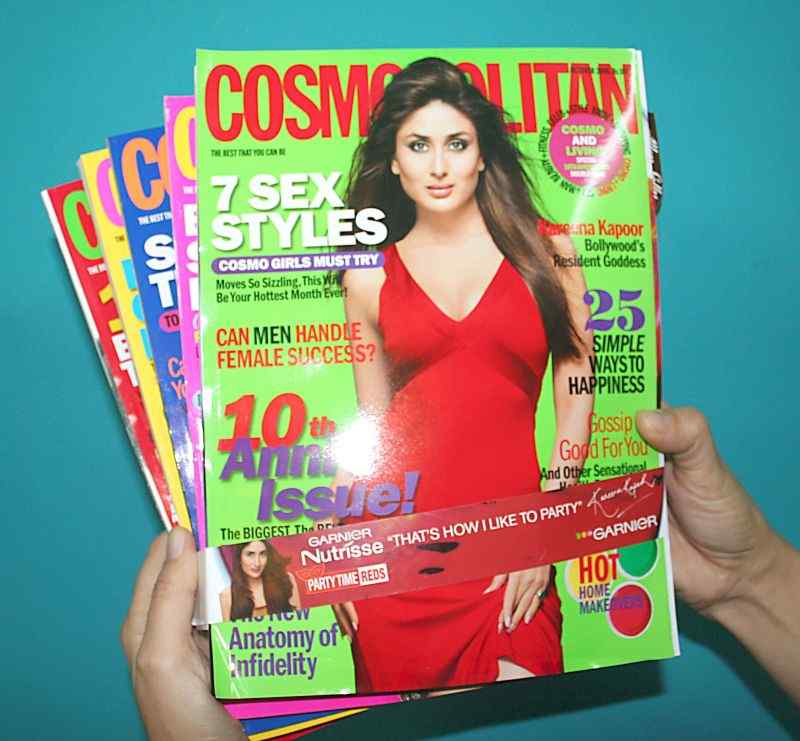
    Article: Five Pounds of Cosmo

    Magazines and newspapers in the U.S. may be going through tough times. But in India, readership and ad revenues are booming says an article on Time.com. Writer Simon Robinson finds that though there are many ways to measure the vibrancy of India's publishing industry, his favourite method of gauging the vitality of India's publishing industry is to weigh it. ;)
    That's what he did with the October issue of Cosmopolitan. At 1,016 pages the issue weighed hefty 4.95 lbs.
    I too was fascinated by the hefty size of Cosmo 10 anniversary issue. And here is what I found:
    Five Pounds of Cosmo has over three pounds of advertisements (a sign that Indian brands trust the power of print media); many editorial spreads that feel like catalogue spreads, much repackaged content (articles and pictures that have been previously seen in Good Housekeeping and Design Today), a few usable articles and tips and not a single memorable layout!
    But I am glad the October issue is broken into into five volumes, makes you feel that you got five issues for the price of one :)

    Labels:

    Tuesday, October 24, 2006

    Article: (Just a Few of) the Worst Mag Covers of All Time!

    It is that time of the year, when awards are going to be announced in all categories related to magazines.
    Media Guy of AdvertisingAge seems to be inspired by last year’s American Society of Magazine Editors' announcement of the "Top 40 Magazine Covers of the Last 40 Years" (also featured in Classics section of magscene.com) to kick off something epic like "Media Guy's Top 41 Worst Magazine Covers of the Last 41 Years"!!

    The worst cover ‘nominee’ featured on the right is the cover of June 2004 issue of Wallpaper called the “The portion control issue,” with the headline 'Size matters: What should be big, what should be small'.

    To see more ridiculous covers, and to read the entire article, click here

    Any bad covers from Indian magazines you want to highlight?

    Labels:

    Tuesday, August 29, 2006

    Article: More than 'Just a Magazine'

    Extracts from Samir Husni’s article on the British magazine industry...

    On every newsstand, I saw three divisions in the British magazine industry:
    Premium Magazines (that lure readers by expensive covermounts): The most noticeable aspect of the Brit magazine industry was their use of covermounts. Over the past few years there has been a rise in the use of covermounts but this recent explosion is unmatched. Premium titles such as Glamour and Tatler have begun including gifts with almost each newsstand edition.
    Newspaper Magazine Supplements
    Covermounts aren't the only thing newspapers have gleaned from the magazine industry: many Brit newspapers are including magazines as well. Every major British paper has at least one supplemental magazine in their weekend edition. Each week The Sunday Times includes magazine supplements that cover style and culture as well as news and events in a more magazine style than the morning paper. These are full-fledged glossy magazines with in-depth features, few advertisements and great design.
    (Magpie adds: Though, I don’t get Hindustan Times, but I assume HT weekend supplement called 'Brunch’ falls into this category)
    Weeklies
    All over the British newsstands you can find a weekly that fits your taste. From celebrities to sex to reality television, weeklies cover every topic you may have a compulsion toward. And this is made even more accessible with the low cost of many of these weeklies. With prices less than a pound and with so many choices the British newsstand is a very reader-friendly environment for weekly titles.

    Husni ends by saying:
    A “newspaper is no longer enough; a magazine is no longer enough; a television show is no longer enough; instead, the newspaper must take the reader from the newsprint to the internet, from the internet to the magazine, from the magazine to the television. Our media must never give a dead end to our readers. We must be constantly sending them to other vehicles where they can consume our product. Otherwise we will be irrelevant and out of touch with our audience”

    For complete unedited article, read: “Welcome to the Publishing 360 World

    Labels:

    Monday, July 24, 2006

    Article: More on Going Digital

    "The magazine - a few pieces of paper glued together - isn't going to be what you're doing in a few years time." ... reiterates futurologist Ian Pearson.

    He cited methods such as incorporating URLs into magazines that link direct to your TV screen and using EInk technologies (prototype large scale newspaper shown in the accompanying pic) by which readers can connect to personalised internet content directly from the magazine. These kinds of technology advances would mean magazine production becomes more of a two-way system, of personalised interaction between the reader and the magazine beyond the traditional means of communication, the letters page.
    "You can make a much clearer link between you and the customer because of the artificial intelligence which knows who I am, where I am and what information I need right now," he told the BBC Magazines conference and reported in the British media trade magazine, the Press Gazette.

    Pearson warned that reputation alone would not carry companies through to the technological revolution, but that the brand value combined with keeping pace with the digital advances would. He added that convergence would mean magazine publishers would face competition from non-traditional publishers, also selling content. "You'll be competing against everybody,"

    Adds Michael Harvey, editor of British TOP GEAR magazine: "Any society that's putting PCs at its centre is extremely relevant to a company that's just selling magazines — it's going to happen here because it's purely determined by the level of penetration and the speed of the broadband there."

    Article Source: Press Gazette Online
    Read full article" Futurologist: publishers must embrace digital age!


    Labels:

    Tuesday, June 27, 2006

    Article: Remembering 'Target' and 'Detective Moochwala'

    Highlights for Children, is dedicated to helping children grow in basic skills and knowledge, in creativeness, in ability to think and reason, in sensitivity to others, in high ideals, and worthy ways of living.
    The magazine, which turns 60 this month, has freshened its look as it competes with video games, television and dozens of other children's magazines, many of which tie into cable networks or spin off of grown-up publications. And this has inspired more than one one-time readers of the magazine to reminisce about the influence of Highlights:
    The lessons conveyed through the cartoon panels - asking parents before adopting a puppy and fulfilling one's promises - are largely unchanged, however, from those that have long modeled good behavior for children
    Also read
    Beloved Magazine turns 60
    Highlights Magazine Freshens Design

    If you are as young as me :) you probably remember Target and its endearing characters 'Detective Moochwala', Ghardab Das and others that we used to wait for every month. It is sad that somewhere in 1991 Target folded up and I don't think I enjoyed any other kids magazine as much after that...
    Perhaps kids were not a very enticing target group to advertisers back then...

    Labels:

    Tuesday, May 30, 2006

    Article: No Magazines for Intelligent Readers like You and Me :)

    Many new English-language media outlets have launched around Asia since the demise of the Far Eastern Economic Review and AsiaWeek (since December 2001)but none have been able to replace them.
    Country-focused Web sites and other regional magazines have yet to find the right formula. As a result, a highly literate and sophisticated market across East Asia remains ill served reports iht in its article: Asia's English readers miss in-depth media

    Labels:

    Wednesday, May 10, 2006

    Article: Print and Online Work Together, Not Apart

    Online presence is an opportunity that magazine publishers cannot afford to ignore for long! But an online presence need not merely be restricted to putting your latest issue and archives on the web.

    My colleague is working on an end user technology website for a magazine publisher. As we were discussing the possiblities and scope of the portal, we realised that this particular media house and also other print publishers in India have not really leveraged online medium to build a community focussed around an area of interest. The only two good examples we could come up with are techtree and Channeltimes by ITNATION.

    Today's opportunity is for the publisher to leverage a magazine brand as the host of a vibrant online community where people not only can find content that they need, but also interact with editors, vendors, and each other.

    The magazine sites that do this best end up looking very little like print publications.

    Bob Carrigan's article Log Off: Print and Online Work Together, Not Apart from OMMA Magazine's May 2006 issue provides some food for thought for magazine publishers and media consultants.

    Labels:

    Wednesday, May 03, 2006

    Article: The Right Way To Do Brand Extensions

    Daniel E. Aks of Folio: argues that too many magazine-industry professionals believe that simply repurposing magazines for the Web constitutes a successful strategy.

    He believes that the challenge is more complicated than just creating companion Web sites or reformatting and reusing content for different media. Publishers need to focus on audience segments and develop an entire range of profitable information services and products for that audience—not only for various media.

    More ideas on generating business leads in his article "The Right Way To Do Brand Extensions"

    Labels:

    Saturday, April 22, 2006

    Article: Print proliferation

    I'd like to think that I noticed this earlier :)

    In the article Print Proliferation in Business Standard, writer Sangeeta Singh wonders if the current frenzy in Indian magazine and newspaper market will last?

    Labels: